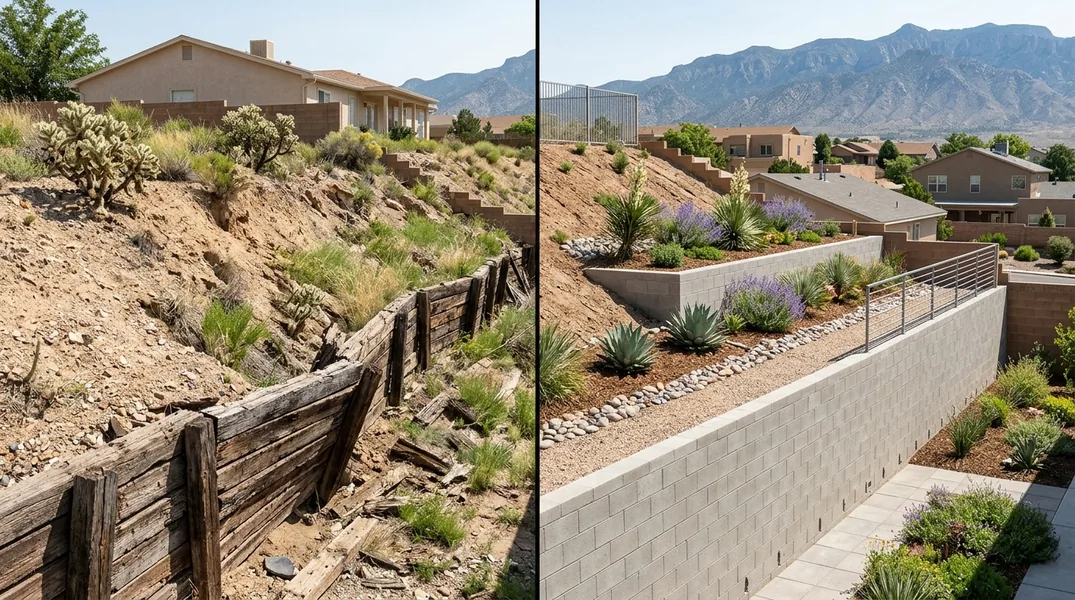
Why Retaining Walls Fail in Albuquerque's Foothills and Valley
Retaining walls in Albuquerque face a unique set of challenges. The city's foothills, with their sloping terrain and sandy, rocky soils, create constant lateral pressure against any wall. Meanwhile, the valley areas sit on expansive clay soils that swell when wet and shrink when dry. This cycle of movement, combined with the region's intense sun and seasonal monsoon rains, puts enormous stress on retaining walls. Many walls that look fine on the surface are quietly losing their structural integrity underneath.
One of the most common culprits is poor drainage. When water accumulates behind a wall, it adds tremendous weight and hydrostatic pressure. In Albuquerque's foothills, where water rushes down slopes during summer storms, a wall without proper drainage features like weep holes or gravel backfill can become saturated quickly. In the valley, clay soils trap moisture, keeping the wall constantly under pressure. Over time, this leads to a leaning retaining wall or one that starts to bow outward.
Common Causes of a Failing Retaining Wall
Beyond drainage, several other factors contribute to wall failure. Inadequate footing is a major issue. A retaining wall must be built on a stable base that extends below the frost line and is properly compacted. In Albuquerque's foothills, where the ground can be uneven and rocky, a shallow or poorly prepared footing will settle unevenly, causing the wall to crack or tilt. Similarly, using the wrong materials for the soil conditions can spell trouble. For example, a timber wall in a valley area with expansive clay may rot or shift much faster than a properly engineered Concrete Retaining Walls.
Another frequent cause is backfill soil that isn't compacted correctly or that contains organic matter. As that material decomposes, voids form and the wall loses support. Tree roots can also exert pressure, especially in older neighborhoods where large trees grow close to walls. And of course, age takes its toll. Even a well-built wall has a lifespan, and without periodic inspection, small problems like hairline cracks or minor bulging can escalate into a full-blown failing retaining wall that requires Retaining Wall Replacement.
Warning Signs You Should Never Ignore
Spotting the early warning signs of a failing wall can save you thousands of dollars in repairs. Start by looking for visible movement. A wall that leans, even slightly, is a red flag. Check for a bowing retaining wall fix before the bulge worsens. You should also inspect the wall for cracks, especially horizontal cracks or stair-step cracks in block walls. These often indicate that the wall is being pushed outward by soil pressure. Another sign is separation between the wall and the soil behind it, or gaps where the wall meets adjacent structures like a patio or driveway.
Don't forget to check drainage. If you see water pooling at the base of the wall or soil washing away, the drainage system is likely clogged or inadequate. In Albuquerque's monsoon season, this can quickly lead to erosion and undermine the footing. Also, look for sinkholes or depressions in the ground behind the wall, which suggest that soil is settling or being washed away. Finally, pay attention to any doors or gates that stick or no longer latch properly near the wall. This can be a subtle sign that the ground is moving. If you notice any of these issues, it's time to call a professional for an inspection.
Retaining Wall Repair Near Me: When to Call a Pro
While minor cosmetic issues like small surface cracks can sometimes be addressed with simple patching, structural problems require expert attention. If you see leaning, bowing, or significant cracking, do not attempt a DIY fix. These are signs that the wall is under stress and could collapse, posing a safety risk. A professional can assess the root cause and recommend the right solution, whether it's reinforcing the existing wall or planning a full replacement. In many cases, timely Retaining Wall Repair can extend the life of your wall and prevent costly damage to your property.
When you search for "retaining wall repair near me" in Albuquerque, look for a contractor with local experience. They'll understand the specific soil conditions in your area, from the foothills to the valley, and can design a repair that addresses the underlying problem. They should also be able to provide a free estimate and explain the options clearly. Don't wait until the wall is beyond repair. Early intervention is key to protecting your landscape and your home's value.
Preventing Future Failures: What Albuquerque Homeowners Can Do
The best way to avoid a failing retaining wall is to ensure it's properly built from the start. If you're planning a new wall, hire a qualified contractor who specializes in Retaining Wall Installation. They should conduct a site assessment, design the wall to handle the specific soil and water conditions, and use high-quality materials. Proper drainage is non-negotiable: a good contractor will incorporate gravel backfill, perforated pipe, and weep holes to manage water. They'll also ensure the footing is deep and stable enough for your location.
For existing walls, regular maintenance goes a long way. Keep an eye on drainage features and clear any debris that might block them. Avoid planting large trees or shrubs too close to the wall, as roots can cause damage. And schedule periodic inspections with a professional, especially after heavy rains or if you notice any changes. If you're in Rio Rancho or Corrales, the same principles apply. A proactive approach will save you money and headaches down the road. If you're unsure about the condition of your wall, reach out to Albuquerque Retaining Wall at (505) 312-9278 for a professional evaluation.
Looking for a professional retaining wall contractor in Albuquerque? Albuquerque Retaining Wall responds fast for all your retaining wall needs.
Get a Free QuoteOur services: Retaining Wall Installation · Retaining Wall Repair · Retaining Wall Replacement