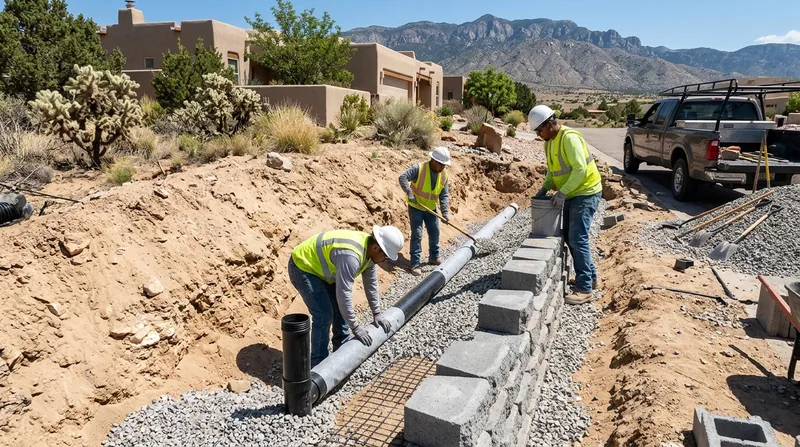




Albuquerque sits on a tilted shelf of ground that runs from the Rio Grande bosque up to the Sandia foothills, and every wall on that shelf is fighting water. On the East Mesa you get collapsible sandy soils and decomposed granite washing down from Placitas and Cedar Crest. Down in the North Valley and Los Ranchos de Albuquerque you get a shallow water table and heavy cottonwood irrigation. Out on the West Mesa you get caliche that traps water instead of draining it. If you are searching for retaining wall drainage in Albuquerque, you already suspect the truth: most walls here do not fail because the block was weak. They fail because water built up behind them and pushed. We install French drains, weep holes, gravel backfill, and waterproofing that relieve that pressure before it leans your wall or drops it into the arroyo. Call us at (505) 312-9278 and we will tell you what your wall actually needs. Start with our retaining wall repair service if the wall is already moving.
Why Drainage Decides Whether Your Albuquerque Wall Survives
Hydrostatic pressure is the number one killer of retaining walls in this city, and the local climate writes the script. July through September monsoon storms dump an inch of rain in an hour onto ground that has baked hard for weeks. That water does not soak in. It sheets off the foothills, loads up behind walls, and finds every missing weep hole. Then winter freeze-thaw cycles crack the stucco and open seams on mortared river rock walls in Nob Hill and Huning Highland. A wall with no drainage path is a dam holding back a reservoir it was never designed for.
- Collapsible sandy soils on the East Mesa lose strength fast when saturated, so backfill pressure climbs with every storm.
- Caliche layers on the West Side and in Rio Rancho stop water from percolating down, forcing it sideways into the wall.
- Decomposed granite washing off Sandia foothill lots in Four Hills and Cedar Crest packs gravel drains and blocks weep holes.
- Shallow water tables near the river in Corrales and Bosque Farms keep the soil behind valley walls wet year round.
- Old railroad tie walls in the Northeast Heights rot from the back face first because they never had a drainage layer.
Fix the water and most walls stop moving. Ignore it and you will be calling us for a leaning wall repair within a couple of seasons.
Key info: A stuccoed CMU wall in High Desert that looked fine in April bulged six inches by August after one monsoon season with no weep holes. Weep holes and gravel backfill would have cost a fraction of the rebuild.
The City of Albuquerque's Planning Department handles permits and inspections for walls that trigger the local thresholds, and drainage details often come up in those reviews.
How We Build a Drainage System That Actually Works Here
We do not just punch a few holes in the wall and call it drained. We read the slope, the soil, and the water source first, then build a system that moves water out and away. On the mesa we deal with sandy fill and caliche shelves. In the valley we deal with a high water table and irrigation runoff. The sequence below is what we run on almost every job, adjusted for what the site shows us.
- We dig test pits behind the wall to see the actual soil layers and where the water is coming from.
- We clear and regrade the backfill so water drains toward the outlet instead of pooling against the wall.
- We install a perforated French drain pipe in a washed gravel trench at the footing, wrapped in filter fabric.
- We core weep holes through CMU and concrete walls at the low points, spaced so no section stays dry.
- We backfill with clean drain gravel instead of the native caliche or decomposed granite that seals up.
- We waterproof the back face of the wall where the soil stays wet, especially on valley lots.
- We daylight the outlet to a swale, a pop-up emitter, or a storm path so the water leaves the wall for good.
Every one of those steps exists to keep pressure off the wall, and we document what we found so you know why the system looks the way it does.
Key info: A boulder wall in Tijeras had a French drain that emptied into a plugged gravel pit ten feet away. We re-routed the outlet downhill to the arroyo and the seeping stopped within a week. See how we handle that kind of grading work on our slope stabilization and erosion control page.
Drainage Approaches We Use on Albuquerque Walls
Not every wall needs the same system. A short garden wall in Los Ranchos de Albuquerque and a tall tiered wall in Four Hills have different water loads and different failure risks. This table shows the main approaches we install and where each one earns its keep.
| Approach | Description | Best for |
|---|---|---|
| French drain behind the wall | Perforated pipe in washed gravel at the footing, wrapped in filter fabric, daylighted downhill. | Tall walls and any wall on a slope that collects runoff. |
| Weep holes and gravel backfill | Cored outlets through CMU or concrete with clean drain rock behind the wall face. | Stuccoed CMU and poured concrete walls in the Northeast Heights. |
| Waterproofing membrane | Sheet membrane or fluid-applied coating on the back face where soil stays damp. | Valley walls near the river with a shallow water table. |
| Surface water control | Regrading, swales, and downspout extensions that keep storm water off the wall. | Foothill lots in Cedar Crest and Placitas with decomposed granite runoff. |
| Chimney and wick drains | Vertical gravel columns that relieve trapped water in tight caliche soils. | West Mesa and Rio Rancho walls sitting on caliche shelves. |
We pick the combination that matches your soil and your wall, not the one that is easiest to sell.
Retaining Wall Drainage Cost in Albuquerque: What to Expect
Drainage work starts at $2,500 for a straightforward French drain and weep hole package on a typical residential wall, and that figure is realistic for a single run with a clear outlet. Most jobs land between that starting point and the mid five figures once you add length, depth, waterproofing, or an outlet that has to be trenched a long way downhill. We price the system, not the hour, so you know what the finished drainage looks like before we start.
- Wall length and height drive the pipe, gravel, and labor quantities more than anything else.
- Soil conditions matter: caliche and decomposed granite cost more to trench than clean sand.
- Outlet distance and grade decide whether we can daylight the drain nearby or need a longer run.
- Waterproofing the back face adds cost but is often required on valley walls with a high water table.
- Access limits on foothill lots in Four Hills or narrow North Valley side yards slow the work down.
Get two or three estimates and compare what each one includes, because a low number that skips the gravel and filter fabric is not the same job. Our full pricing overview breaks down the components so you can compare line by line.
Retaining Wall Drainage Near Me: How to Vet a Contractor Near Albuquerque
Drainage is invisible when it is done right, which means you are hiring on trust. Ask for the license and insurance certificate before anyone touches your wall, and confirm the coverage is current. Get at least three written estimates and compare the scope, not just the total. Call references from jobs in your part of town, because a contractor who works the valley may not understand caliche on the West Mesa.
- Confirm the contractor is fully insured and ask for the certificate by email.
- Check references from walls similar to yours, in similar soil and slope conditions.
- Ask whether a permit is required for your wall height and who pulls it.
- Get the drainage outlet plan in writing so you know where the water goes.
- Ask for a written scope that names pipe size, gravel type, and filter fabric.
Permit thresholds vary by jurisdiction, so we always confirm with the local building department before we schedule the work. When you are ready to talk, reach us through our contact and free estimate page and we will set up a site visit.
Retaining Wall Drainage in Albuquerque: Pricing Guide
| Service | Price | Details |
|---|---|---|
| French drain and weep hole package | Starting at $2,500 | Perforated pipe, washed gravel, filter fabric, and cored weep holes on a typical residential wall. |
| Waterproofing and gravel backfill | Starting at $3,200 | Back face membrane plus clean drain rock, priced by wall length and soil depth. |
| Full drainage retrofit with long outlet run | Starting at $6,500 | Adds trenching to a distant daylight point and regrading on sloped foothill lots. |
| Complex or large-scale job | On estimate | Tiered walls, caliche shelves, and tight access need an on-site look before we price. |
| Travel | Included | In Albuquerque and surrounding areas, no separate call-out or mileage fee. |
| Estimate | Free | Response within 24h at (505) 312-9278, no obligation to book. |
Indicative pricing, the exact cost depends on square footage, finish, and site access. Free personalized estimate within 24h at (505) 312-9278.


