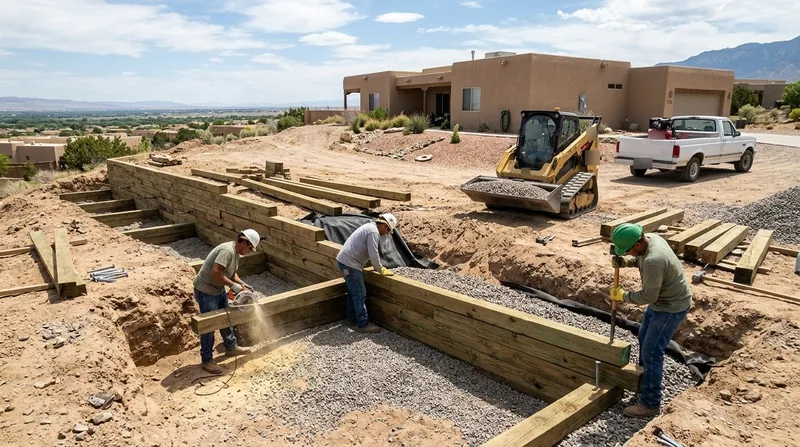




Timber Retaining Walls in Albuquerque
Albuquerque sits on a shelf of collapsible sandy soils, caliche, and decomposed granite that runs from the Rio Grande bosque up to the Sandia foothills, and a timber wall has to hold that ground through freeze-thaw winters and July monsoon gully washers. We build Timber Retaining Walls in Albuquerque for raised garden beds, low terraces, and budget-conscious grade changes on lots from the North Valley to the East Mesa. Pressure-treated timber is the cheapest wall material you can put in the ground here, and it is also the one that ages fastest under our high-altitude sun. We tell you straight which jobs timber handles well and which jobs will eat a wood wall alive. If your existing wall is already bowing or rotten, start with leaning and collapsed wall repair before you spend a dollar on new material.
Why Timber Walls Fail Fast in Albuquerque's Sun and Soil
Albuquerque gets roughly 3,400 hours of sun a year and single-digit humidity most of the summer, which pulls moisture out of wood and opens checks along the grain. Add our freeze-thaw cycle (nights below freezing, afternoons in the 50s) and a treated 4x6 or 6x6 starts losing section within a decade. The bigger problem is what the wall holds back: sandy valley soils and decomposed granite off the foothills wash out through the joints and pile pressure behind the timber.
- UV exposure dries and splits the face of untreated or lightly treated timbers within two or three summers.
- Poor drainage lets water build hydrostatic pressure that pushes a low timber wall forward at the base.
- Caliche layers trap water against the back of the wall instead of letting it weep through.
- Cottonwood roots and irrigated farm-lot soils in the North Valley keep the ground saturated longer than most homeowners expect.
- Old railroad tie beds, common in Nob Hill and the Northeast Heights, rot from the inside out and show almost no warning on the face.
We inspect the soil, the slope above the wall, and the drainage path before we quote a timber build, because a wall that ignores water is a wall we will be repairing in five years.
Key info: On a North Valley lot near Rio Grande Boulevard, a 3-foot timber terrace holding back irrigated garden soil had rotted through at the base course after 11 years. The homeowner's fix was not more timber; it was a drainage correction and a shorter wall. We rebuilt it at 24 inches with a gravel backfill and it has held through three monsoon seasons.
For the official rules on wall height, footings, and permits, check the City of Albuquerque's Planning and Development pages at cabq.gov/planning before you dig.
How We Build a Timber Wall That Lasts in Albuquerque
We do not drop a timber wall on bare dirt and call it done. Every build starts with the ground: we strip organics, cut a level trench to the footing depth, and compact a gravel base so the first course sits on something that will not settle. Then we set the drainage plane before the wall goes up, not after.
- We walk the site and measure the grade change, the slope above, and the water path from the arroyo or downspout that feeds the area.
- We excavate to the footing depth and compact a crushed gravel base, deeper on the sandy East Mesa lots than on valley clay.
- We set pressure-treated timbers in deadmen or tieback configuration where the wall holds a surcharge, and we spike and stagger the courses.
- We install a gravel drainage column and filter fabric behind the wall, with weep points at the base.
- We cap the top course and check plumb, line, and height against the permitted plan before we backfill.
Every step is documented with photos so you have a record of what is buried behind the wall.
Key info: In Four Hills, a homeowner wanted a 4-foot timber wall to terrace a decomposed granite slope. The wall crossed the permit threshold, so we pulled an engineered plan, set the footing deeper, and added a drainage blanket. The same wall built without that drainage would have leaned within two winters.
If your site needs more than timber can offer, see our slope stabilization and erosion control page for the options we use on foothill lots.
Timber Wall Methods We Use in Albuquerque
The right timber approach depends on how tall the wall is, what it holds back, and how much room you have for a proper footing and drainage. These are the four configurations we build most often in Albuquerque and the surrounding towns.
| Approach | Description | Best for |
|---|---|---|
| Low garden terrace (under 24 inches) | Two or three courses of 4x6 treated timber on a compacted gravel base with a fabric-wrapped drainage column. | Raised vegetable beds and small grade changes on North Valley and Corrales lots. |
| Deadman-anchored wall (24 to 48 inches) | Staggered 6x6 courses with deadmen tying the wall back into the retained soil, plus a gravel drainage blanket. | Terracing a sloped yard in the Northeast Heights or Placitas foothills. |
| Tiered timber wall | Two or more short walls stepped back into the slope, each with its own footing and drainage. | Larger grade changes where a single tall timber wall would exceed permit thresholds. |
| Timber to block transition | Timber for the low decorative courses, block or segmental units where the wall carries real load. | Homeowners who want the timber look but need a wall that will outlast treated wood. |
We will tell you when the honest answer is to skip timber and use a longer-lasting material, and we will show you why on site.
Timber Retaining Walls Cost in Albuquerque: What to Expect
Timber is the budget option, and our pricing reflects that. Expect work to start around $20 per square foot for a straightforward low terrace on accessible ground. That figure moves with wall height, footing depth, the amount of excavation, and whether we are tearing out an old railroad tie bed first. A wall that needs an engineered plan or a tiered design costs more because there is more design and inspection time in it.
Three things push the number up fastest in Albuquerque: caliche that has to be broken out by machine, tight access where a truck cannot reach the back yard, and any wall that crosses the permit threshold and needs stamped drawings. We quote the drainage and the footing separately from the timber so you can see exactly what you are paying for. Get two or three written estimates and compare the drainage scope line by line, not just the total. Our full pricing overview breaks down the ranges.
What to Look For in a Timber Wall Contractor Near Me in Albuquerque
Timber walls are cheap to build badly and expensive to fix, so hire on process, not on the lowest bid. Ask how the contractor handles drainage, because a bid that does not mention gravel backfill or filter fabric is a bid for a wall that will lean.
Call at least two references from jobs in your part of town, and ask whether the wall has moved. Confirm who pulls the permit, and check with the City of Albuquerque before any work near a protected tree or a property line. If you are in an HOA in Rio Rancho or the West Side, get the architectural approval in writing before the first timber is cut. Reach us through the contact and free estimate page and we will walk the site with you.
Key info: A Los Lunas homeowner got three bids on a 30-inch timber terrace. The low bid skipped the drainage column. The middle bid included it. Two years later the low-bid wall was leaning into the patio and the middle bid was still plumb. The difference was about $600 in gravel and fabric.
If you are replacing an old railroad tie wall rather than starting fresh, our railroad tie wall replacement page covers what we find behind those beds and how we handle the disposal.
Timber Retaining Walls in Albuquerque: Pricing Guide
| Service | Price | Details |
|---|---|---|
| Low timber garden terrace | Starting at $20/sq ft | Includes gravel base, two to three treated courses, and a fabric-wrapped drainage column. |
| Deadman-anchored timber wall | Starting at $32/sq ft | Includes 6x6 courses, tiebacks, drainage blanket, and excavation to footing depth. |
| Tiered timber wall system | On estimate | Multiple stepped walls need an on-site look at grade, access, and permit thresholds before pricing. |
| Railroad tie tear-out and rebuild | On estimate | Disposal of rotted ties and unknown soil conditions behind the old bed require inspection first. |
| Travel | Included | In Albuquerque and surrounding areas, no separate call-out or mileage fee. |
| Estimate | Free | Response within 24h at (505) 312-9278, no obligation to book. |
Indicative pricing, the exact cost depends on square footage, finish, and site access. Free personalized estimate within 24h at (505) 312-9278.


