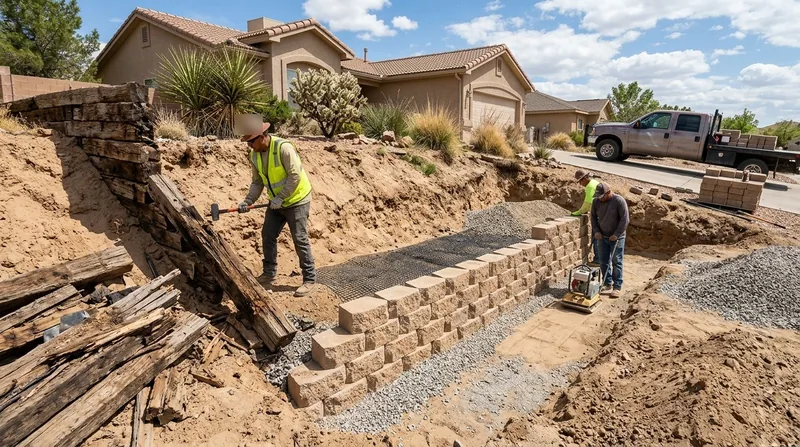




Railroad Tie Wall Replacement in Albuquerque: Tear Out the Old Creosote and Build It Right
Albuquerque sits in a high desert bowl where the Rio Grande cuts a green cottonwood corridor through the valley and the Sandias throw a hard shadow over the East Mesa. Those 1970s and 1980s railroad tie walls are still holding up half the yards in the Northeast Heights, the North Valley and the foothills, and most of them are past their service life. If you are looking for Railroad Tie Wall Replacement in Albuquerque, you already know the signs: ties that are rotting from the inside out, creosote bleeding onto the stucco, a wall that has started to lean toward the driveway. We pull the old ties, haul them off legally, and rebuild in segmental block, stuccoed CMU or natural stone with real drainage behind it. Call (505) 312-9278 for a free on-site look. You can also read how we handle full retaining wall replacement when the whole structure has to come down.
Why Railroad Tie Walls Fail Faster in Albuquerque's Soil and Sun
Creosote-treated ties were never meant to last 40 years in a climate that swings from 15°F winter nights to 100°F July afternoons. Here the failure mode is specific: collapsible sandy soils and decomposed granite wash down from the foothill lots, the shallow water table near the river keeps the bottom courses wet, and the July-to-September monsoon dumps an inch of rain in an hour. The tie soaks, the wood checks and splits, and the wall loses its batter. Ties also rot from the back face where nobody can see it, so a wall that looks fine from the street can be hollow behind the header.
- Creosote leaches into the soil and stains stucco, concrete and pavers along the North Valley and Los Ranchos properties.
- Old ties were set with little or no gravel backfill, so hydrostatic pressure pushes the wall out after every monsoon.
- Freeze-thaw cycles open the checks in the wood and let water drive deeper each winter.
- Caliche layers trap water against the base and rot the bottom two courses first.
- Many tie walls were built too tall for their footing, and they lean once the soil behind them saturates.
When the wall is already leaning or bulging, the fix is usually a full rebuild, not a patch, and that is where our leaning and collapsed wall repair crew gets involved.
Key info: A tie wall in Corrales that sits two feet from the irrigation ditch will rot out years before an identical wall up in Four Hills. Water exposure, not age, is what kills these walls in Albuquerque.
Before any rebuild, check the permit threshold with the City of Albuquerque Planning Department, since walls over roughly 4 feet from the footing or walls carrying a surcharge often need a permit and sometimes engineered drawings. The city planning page is the place to confirm the current rule for your lot.
How We Replace a Railroad Tie Wall in Albuquerque, Step by Step
Every job starts with a walk of the wall line and a look at what is actually holding the soil. We probe the footing, check for utilities, and measure how much grade the wall is carrying. Then we sequence the tear-out so the slope above never sits open overnight. On a typical Northeast Heights lot we can demo and haul a 40-foot tie wall in a day and have the new base gravel and drainage in by the next.
- We mark utilities and confirm the property line before any tie comes out.
- We cut the old ties free, pull them with a mini excavator where access allows, and load them for legal disposal.
- We excavate to a stable bearing layer, which often means digging past the caliche and into undisturbed soil.
- We set a compacted gravel footing and start the new wall with proper batter.
- We install drain rock, filter fabric and weep points so water never loads the wall again.
- We cap the wall and backfill in lifts, compacting as we go.
- We haul off all debris and leave the yard clean and walkable.
If the slope above the wall is moving, we bring in the slope stabilization and erosion control crew before the new wall goes in.
Key info: On a recent job in the 87107 ZIP near Los Ranchos, a 1978 tie wall had rotted through at the base and was pushing into the driveway. We replaced it with a stuccoed CMU wall tied into a new gravel footing, matched the existing adobe finish, and added a French drain that carries monsoon runoff to the street.
Rebuild Options: What Replaces the Old Ties
Once the ties are out, you have three practical choices in Albuquerque, and each one fits a different lot. Segmental block is the fastest and handles the sandy East Mesa soils well. Stuccoed CMU matches the Pueblo Revival and stucco ranch homes that dominate the older neighborhoods. Natural stone and boulder work fits the foothill lots where the wall has to look like it grew there.
| Approach | Description | Best for |
|---|---|---|
| Segmental block | Interlocking concrete block with gravel core and geogrid where needed. | East Mesa and West Side lots with sandy soil and moderate height. |
| Stuccoed CMU | Grouted block wall finished to match the house. | North Valley, Huning Highland and Nob Hill homes that need a finished face. |
| Natural stone or boulder | Basalt or river rock laid dry or mortared with heavy base. | Foothill and arroyo-edge lots in Tijeras, Cedar Crest and Placitas. |
| Timber rebuild | New pressure-treated timber where the look is wanted and height is low. | Garden walls under 3 feet on well-drained lots. |
If you want the block route, see our block and segmental retaining walls page for details on geogrid and drainage.
Railroad Tie Wall Replacement Cost in Albuquerque: What to Expect
Most tie wall replacements in Albuquerque start around $35 per square foot of wall face, and that figure moves with height, access and finish. A low garden wall on a flat lot in the Heights is at the bottom of the range. A tall wall on a tight foothill lot in Four Hills, where the excavator cannot get behind the house, runs higher. Demolition and legal disposal of creosote-treated ties add cost on every job, and so does hauling off soil that has to be replaced with clean gravel.
Finishes change the number too. Stuccoed CMU costs more than plain block because of the lath, scratch coat and finish coat. Natural stone runs higher again on labor. Engineered drawings, which many jurisdictions require for tall or tiered walls, are a separate line item. Get two or three written estimates on the same scope so you are comparing the same wall, not three different walls. Our full pricing overview breaks down the ranges by wall type and height.
Railroad Tie Wall Replacement Near Me: How to Pick a Contractor in Albuquerque
Searching for railroad tie wall replacement near me in Albuquerque turns up a lot of names, and not all of them carry the right coverage. A retaining wall is a structural item, so the crew you hire should be fully insured for the work, not just handy with a skid steer. Ask for the certificate of insurance before work starts, and confirm the policy covers excavation and demolition, not just finish work.
- Get two or three written estimates that list demolition, disposal, drainage and finish separately.
- Ask for references from jobs in your part of town, ideally a wall that has been through at least one monsoon season.
- Confirm who pulls the permit if your wall crosses the height or surcharge threshold.
- Check HOA rules on wall height, color and finish before the block is ordered.
Reach us through the contact page or call (505) 312-9278 to set up a free estimate.
Railroad Tie Wall Replacement in Albuquerque: Pricing Guide
| Service | Price | Details |
|---|---|---|
| Low garden wall replacement | Starting at $35/sq ft | Includes tie demolition, haul-away, new gravel footing and drainage; height and access move the price. |
| Standard block rebuild | Starting at $45/sq ft | Segmental block with gravel core and filter fabric; wall height and geogrid requirements drive cost. |
| Stuccoed CMU rebuild | Starting at $58/sq ft | Grouted block with lath and stucco finish; finish matching and wall length affect the total. |
| Natural stone or boulder rebuild | On estimate | Stone size, haul distance and tight foothill access require an on-site look before pricing. |
| Travel | Included | In Albuquerque and surrounding areas, no separate call-out or mileage fee. |
| Estimate | Free | Response within 24h at (505) 312-9278, no obligation to book. |
Indicative pricing, the exact cost depends on square footage, finish, and site access. Free personalized estimate within 24h at (505) 312-9278.


