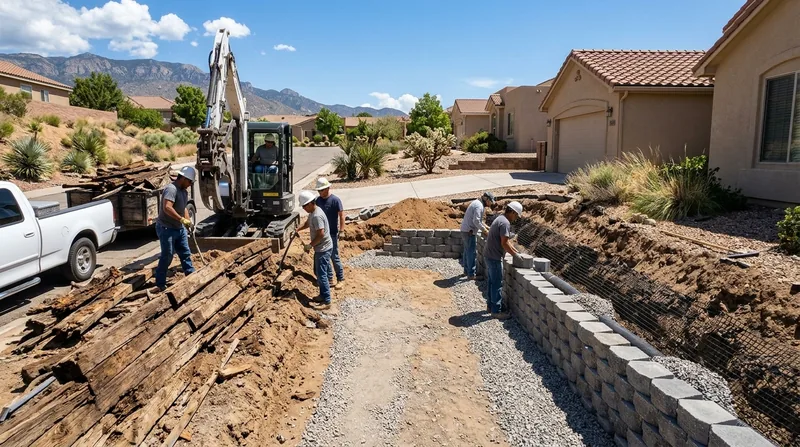




Albuquerque sits on a tilted stage: the Rio Grande bosque and irrigated farm lots down in the valley, the East Mesa climbing to the Sandia foothills, and the volcanic escarpment of the West Mesa on the other side. Walls here hold back collapsible sandy soils, caliche, and decomposed granite, and they take a beating from winter freeze-thaw and July to September monsoon storms that push water through arroyos and side yards. When an old wall finally lets go, Retaining Wall Replacement in Albuquerque is the fix that stops the slide and protects the house, driveway, or patio above it. We tear out failed railroad tie beds, cracked block, and settling mortared river rock, then rebuild with modern engineered materials and drainage that actually works. If your wall is leaning but still standing, start with retaining wall repair; if the structure is done, replacement is the smarter money.
Why Retaining Wall Replacement Matters in Albuquerque's Soil and Climate
The failure mode that dominates here is water. Our sandy, collapsible soils and caliche layers shed monsoon runoff fast, and a wall built without proper drainage or compacted backfill starts bulging within a few seasons. Add freeze-thaw cycling in January and February, and cracks open and widen. In the foothills, decomposed granite washing off graded lots loads walls from behind; near the river, a shallow water table keeps the soil wet and heavy.
- Old railroad tie walls in the North Valley and Huning Highland neighborhoods rot from the inside out and lose their tiebacks.
- Stuccoed CMU walls on 1950s to 1970s stucco ranches in the Northeast Heights crack and settle when footings sit on unprepared soil.
- Mortared river rock and basalt boulder walls in Corrales and Los Ranchos de Albuquerque fail when mortar joints crumble and water gets behind the face.
- Gabion walls along arroyos in Tijeras and Cedar Crest rust out and spill rock after major monsoon events.
Replacement is not cosmetic. It restores the load path, the drainage, and the tieback system in one pass, which is why we rarely recommend patching a wall that has already moved.
Key info: A wall in Albuquerque's East Mesa foothills that shows a 2-inch lean after one monsoon season is usually a drainage failure, not a materials failure. Replacing it without fixing the water path just resets the clock.
Most jurisdictions in the Albuquerque area require a permit once a wall exceeds roughly 4 feet measured from the footing, or when it supports a surcharge such as a driveway or structure. Always confirm the current threshold with the local building department before work starts. You can review contractor licensing through the New Mexico Regulation and Licensing Department.
How We Replace a Failed Wall in Albuquerque, Step by Step
Every replacement starts with a site assessment, not a guess. We look at soil type, slope, surcharge loads, and where the water actually goes during a storm. Then we plan demolition, haul-away, and rebuild around your access, your utilities, and your neighbors.
- We walk the site with you and identify the failure cause, whether it is drainage, footing, soil, or age.
- We pull the permit where required and coordinate any engineering drawings for tall or tiered walls.
- We demolish the old wall and haul away ties, block, rock, and debris.
- We excavate to stable bearing soil and build a proper compacted base and footing.
- We install drainage, filter fabric, and free-draining backfill behind the new wall.
- We build the new wall in engineered block, poured concrete, boulder, or timber to match your home and budget.
- We backfill, compact in lifts, and finish the grade so water runs away from the wall.
On a recent job in the Sandia foothills near Cedar Crest, we replaced a 60-foot rotting railroad tie wall that had pushed a decomposed granite slope into a driveway. The new segmental block wall included a drainage swale and a compacted gravel backfill, and it has handled two monsoon seasons without movement.
We handle replacements across the valley and the mesas, including Rio Rancho and the 87144 area where graded lots and expansive soils create their own set of problems.
Replacement Approaches We Use in Albuquerque
The right replacement material depends on load, height, soil, and how the wall fits your home. A Pueblo Revival house in Old Town may call for stuccoed block, while a foothill lot with a boulder wall should usually stay boulder. Here is how the main approaches compare.
| Approach | Description | Best for |
|---|---|---|
| Segmental block (SRW) | Engineered interlocking block with geogrid reinforcement and gravel backfill. | Taller walls, tiered walls, and most residential replacements. |
| Poured concrete | Cast-in-place reinforced wall with formed face and drainage board. | Driveway surcharges, structural loads, and tight lots. |
| Boulder and natural stone | Basalt or river rock placed and keyed with proper batter and drainage. | Foothill lots, arroyo edges, and natural landscape settings. |
| Timber and tie replacement | Pressure-treated timber or modern tie replacement with drainage. | Low garden walls and budget-driven replacements. |
Whichever approach we use, the drainage detail matters as much as the face material. A wall without drainage is a wall waiting to fail again.
Retaining Wall Replacement Cost in Albuquerque: What to Expect
Replacement pricing starts at From $35 per square foot of wall face for basic segmental block work with standard access and drainage. That figure moves with height, soil conditions, demolition volume, and material choice. A 3-foot garden wall in the Northeast Heights sits near the low end; a 6-foot engineered wall holding a driveway in Four Hills lands well above it.
- Wall height and total square footage drive the base number more than anything else.
- Demolition and haul-away add cost when the old wall is concrete, mortared rock, or buried tieback timber.
- Soil conditions such as caliche, collapsible sand, or a high water table near the river require over-excavation and imported backfill.
- Access matters: a wall behind a house in Corrales with no equipment path costs more than one facing the street.
- Engineering and permits apply to walls above the local threshold or any wall carrying a surcharge.
Get two or three written estimates and compare scope, not just the bottom line. For a fuller breakdown by wall type and size, see our retaining wall pricing page.
Retaining Wall Replacement Near Me: How to Choose a Contractor in Albuquerque
When you search for retaining wall replacement near me in Albuquerque, the first thing to verify is fully insured status. Then ask how the contractor handles drainage and compaction, because those two details separate a wall that lasts from one that leans in three years.
- Get at least three estimates in writing with scope, materials, and drainage details spelled out.
- Ask for references from jobs in your part of town, ideally walls that have been through a full monsoon season.
- Confirm who pulls the permit and whether engineered drawings are required for your wall height.
- Check HOA rules before work starts, especially in planned communities on the West Side and in Rio Rancho.
- Ask how they will protect landscaping, irrigation lines, and neighboring property during demolition.
If a contractor cannot explain the drainage plan in plain terms, keep looking. Ready to talk through your wall? Contact us for a free estimate and we will walk the site with you.
Retaining Wall Replacement in Albuquerque: Pricing Guide
| Service | Price | Details |
|---|---|---|
| Basic block wall replacement | Starting at $35/sq ft | Includes demolition, haul-away, compacted base, drainage, and standard segmental block with normal access. |
| Engineered tall or tiered wall | Starting at $55/sq ft | Includes geogrid reinforcement, engineered drawings, and over-excavation for walls above 4 feet. |
| Boulder and natural stone replacement | Starting at $60/sq ft | Includes basalt or river rock placement, keyed batter, and drainage for foothill or arroyo settings. |
| Railroad tie and timber replacement | Starting at $40/sq ft | Includes removal of rotted ties and tiebacks, new drainage, and modern block or treated timber. |
| Complex or large-scale job | On estimate | Needs an on-site look when access is tight, soils are poor, or a surcharge structure is involved. |
| Travel | Included | In Albuquerque and surrounding areas, no separate call-out or mileage fee. |
| Estimate | Free | Response within 24h at (505) 312-9278, no obligation to book. |
Indicative pricing, the exact cost depends on square footage, finish, and site access. Free personalized estimate within 24h at (505) 312-9278.


