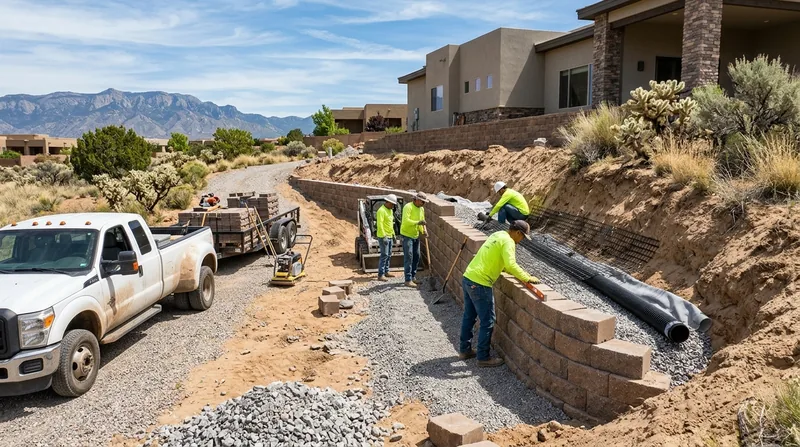




Retaining Wall Installation in Albuquerque: Built for Sand, Caliche, and Monsoon Runoff
When you need Retaining Wall Installation in Albuquerque, the ground under your lot decides everything. Albuquerque runs from the cottonwood bosque and irrigated farm lots of the Rio Grande valley up the East Mesa to the Sandia foothills, and west to the volcanic escarpment of the West Mesa. Each zone fails differently: collapsible sandy soils on the mesa, caliche layers that fight every shovel, decomposed granite washing off foothill lots, and a shallow water table near the river. We design and build walls that hold on that ground, with proper footings, gravel backfill, and drainage. Whether you are terracing a High Desert slope or replacing a rotting tie wall in the North Valley, we build it to stay put through freeze-thaw and the July to September monsoon. See how we handle retaining wall repair when an existing wall is already moving.
Why Retaining Wall Installation Matters on Albuquerque's Slopes and Soils
Most wall failures we see in Albuquerque start with water and bad fill, not with the block itself. Sandy mesa soil collapses when it gets saturated, caliche shelves trap water against a wall face, and decomposed granite on foothill lots runs downhill with every monsoon storm. Add winter freeze-thaw and bright high-desert sun baking the stucco, and a wall built without drainage is on a clock. New construction done right solves all of it at once.
- We excavate to undisturbed soil or engineered fill, not loose surface sand.
- We set footings below the local frost line and size them for the wall height.
- We install gravel backfill and drain pipe so water never sits behind the wall.
- We tie tiered walls into the slope instead of stacking them as separate walls.
- We match the finish to the neighborhood, from stuccoed CMU to basalt boulders.
That combination is what keeps a wall plumb through a decade of monsoon seasons and freeze-thaw cycles.
Key info: In Four Hills and Placitas, we routinely find decomposed granite sitting on top of caliche. Water perches on the caliche and pushes against the wall. A footing keyed into the caliche plus a gravel drainage blanket stops that push before it starts.
For permit thresholds and setback rules, check with the City of Albuquerque Planning and Development Department before you build. Many jurisdictions require a permit for walls above roughly 4 feet measured from the footing, or when the wall supports a driveway or structure, and engineered drawings may be required for tall or tiered walls. The city planning department is the authority on what your specific lot needs.
How We Build a Retaining Wall in Albuquerque, Step by Step
Every wall starts with a site visit, because the soil and slope tell us more than any drawing. We probe the ground, check where water runs during a storm, and look at what sits above and below the wall line. Then we build in a fixed sequence so nothing gets skipped.
- We walk the site and mark the wall line, checking setbacks and utility locates.
- We excavate to stable soil and bench the slope behind the wall.
- We pour or compact the footing and base course to the right depth and width.
- We set the first course dead level, because every course above depends on it.
- We build up in lifts, compacting backfill and installing drain gravel and pipe as we go.
- We cap the wall, finish the face, and restore the grade and landscaping above it.
Each step gets checked before the next one starts, so a mistake never gets buried under fill.
Key info: On a terraced lot in High Desert, we built three block walls stepping up a 12-foot grade. Each wall got its own footing and drain, and the upper walls were set back far enough to avoid loading the lower ones. The homeowner gained a usable patio level and the slope stopped eroding into the arroyo.
If your lot drains toward an arroyo, pair the wall with slope stabilization and erosion control so the ground above the wall stays where it belongs.
Retaining Wall Methods We Use Across Albuquerque
The right method depends on height, soil, finish, and budget. Here is how the main approaches compare on Albuquerque ground.
| Approach | Description | Best for |
|---|---|---|
| Poured concrete | Cast-in-place reinforced wall, often stuccoed to match Pueblo Revival homes | Tall walls, surcharge loads, tight lots in Nob Hill and Old Town |
| Block and segmental (SRW) | Interlocking gravity or geogrid-reinforced block systems | Terraced gardens, curved walls, most residential slopes |
| Boulder and natural stone | Basalt boulders or mortared river rock set into the slope | Foothill lots, arroyo banks, naturalistic landscapes in Corrales |
| Timber and tie walls | Pressure-treated timber or tie construction with gravel backfill | Low garden walls, budget projects, temporary holds before replacement |
| Gabion walls | Rock-filled wire baskets set along drainage channels | Arroyo edges and fast-moving monsoon runoff paths |
We pick the method after we see the soil and the water path, not before.
Retaining Wall Installation Cost in Albuquerque: What to Expect
Most new retaining walls in Albuquerque start around $30 per square foot of wall face, and that figure moves with height, soil, access, and finish. A low block wall on flat ground in Los Lunas sits near the bottom of the range. A tall stuccoed concrete wall on a steep Four Hills lot with caliche and narrow access sits well above it. We quote from the footing up, including excavation, backfill, drainage, and finish.
Two or three estimates is the smart move on any wall project. Ask each contractor what is included, how they handle drainage, and whether the price covers permits and haul-off. A low bid that skips the drain gravel usually costs more later. Our full pricing overview breaks down what drives the number.
Hiring a Retaining Wall Contractor Near Me in Albuquerque: What to Check
Retaining walls are structural, so hire the way you would hire a foundation contractor. Start with license and insurance, then verify the rest before you sign anything.
- Confirm the contractor is fully insured, and ask for a certificate.
- Get at least two or three written estimates with the same scope so you can compare.
- Ask for references from walls similar to yours, and go look at them.
- Ask who pulls the permit and whether engineered drawings are needed for your height.
- Check HOA rules and property-line setbacks before the first shovel hits the ground.
Ten minutes of checking saves months of arguing with a wall that was never built right.
Ready to talk through your slope? Contact us for a free estimate and we will walk the site with you.
Retaining Wall Installation in Albuquerque: Pricing Guide
| Service | Price | Details |
|---|---|---|
| Block and segmental wall (SRW) | Starting at $30/sq ft | Includes excavation, compacted base, block, drain gravel and cap; height and geogrid add cost |
| Poured concrete wall, stucco finish | Starting at $45/sq ft | Includes formwork, rebar, pour and stucco; surcharge loads and tight access push the price |
| Boulder and natural stone wall | Starting at $50/sq ft | Includes basalt or river rock, setting and backfill; haul distance and stone size drive the number |
| Tiered or engineered wall | On estimate | Needs an on-site look because soil, slope height and engineering requirements vary by lot |
| Travel | Included | In Albuquerque and surrounding areas, no separate call-out or mileage fee |
| Estimate | Free | Response within 24h at (505) 312-9278, no obligation to book |
Indicative pricing, the exact cost depends on square footage, finish, and site access. Free personalized estimate within 24h at (505) 312-9278.


