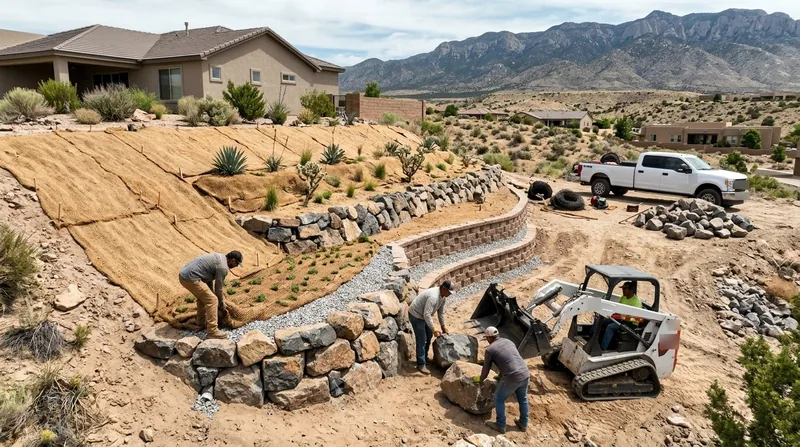




Albuquerque sits on ground that moves. From the sandy East Mesa slopes above Tramway to the decomposed granite washing off Sandia foothill lots in Four Hills and Cedar Crest, and the arroyo banks cutting through the West Side and Rio Rancho, every heavy July storm tests what holds your soil in place. Slope Stabilization & Erosion Control in Albuquerque means reading that ground correctly: collapsible sandy soils, caliche layers that trap water, and a shallow water table near the Rio Grande bosque all fail differently. We build terraced walls, geogrid reinforcement, and drainage that keep hillsides, driveways, and foundations where they belong. Whether your slope is shedding mud into a neighbor's yard or a wall at the top is starting to lean, we scope the fix before the next monsoon. For walls already showing distress, start with leaning and collapsed wall repair.
Why Slope Stabilization Matters on Albuquerque's Foothills and Mesa Edges
Most slope failures we see here are not dramatic landslides. They start small: a rut behind a wall, a crack opening along the top of a footing, dirt piling against a stucco fence after a storm. On cut-and-fill lots in the Northeast Heights and High Desert, builders compacted fill decades ago, and water finds the seam between native soil and fill. Near the river in Los Ranchos and Corrales, a high water table softens the base. Up in Tijeras and Edgewood, decomposed granite runs off steep lots and undercuts whatever sits below.
- Monsoon downpours flood arroyos and saturate slopes in a single afternoon, so drainage capacity matters more than wall height.
- Winter freeze-thaw cycles pry apart mortar joints and heave footings that were never set below frost depth.
- Sandy mesa soils collapse when they get wet, which pulls support out from under driveways and patios.
- Caliche forms a hardpan that sheds water sideways, concentrating flow exactly where you do not want it.
- Old railroad tie and timber beds rot out after 20 to 30 years and stop holding the slope at all.
We fix the water problem and the soil problem together, because a wall alone will not stabilize a slope that keeps getting soaked.
Key info: A homeowner in Four Hills called after a July storm sent mud and rock across the driveway from the hillside above. The old timber bed had rotted through. We replaced it with a terraced segmental block wall, geogrid, and a surface drain that now carries storm flow around the house instead of through the yard.
Permits for walls and grading are handled by the local building department, and thresholds vary by jurisdiction, especially above roughly 4 feet measured from the footing or when a wall supports a surcharge like a driveway. Check the City of Albuquerque's planning and permitting resources at cabq.gov/planning before you build.
How We Stabilize a Slope in Albuquerque, Step by Step
Every slope job starts with water. We walk the lot, find where storm flow enters and leaves, and check the soil profile. Then we design the fix around the actual failure mode, not a generic wall spec. On foothill lots we often terrace two shorter walls instead of one tall wall, because tiered walls handle the grade change with less excavation and less risk. On arroyo banks we armor the toe and redirect flow.
- We inspect the slope, existing walls, drainage paths, and any signs of movement like cracks or soil bulges.
- We identify the water source and design surface and subsurface drainage to move it away from the slope.
- We excavate to stable soil or rock and shape the slope to the designed grade.
- We install geogrid reinforcement in lifts behind terraced walls to tie the soil mass together.
- We build the wall system, whether segmental block, poured concrete, or boulder, and set proper backfill and compaction.
- We finish with erosion control, including gravel, vegetation, or channel armoring where runoff concentrates.
The result is a slope that drains, holds, and does not need emergency attention after every storm.
Key info: In Rio Rancho, a graded lot behind a stucco home was shedding sand onto a lower patio every time it rained. We cut the slope back to a gentler grade, added a low block wall at the toe, and tied it in with geogrid. The patio has stayed clean through two monsoon seasons.
If the slope problem sits around your foundation rather than a property edge, see our retaining wall drainage page for how we handle water behind walls.
Approaches We Use for Slope Stabilization and Erosion Control
The right approach depends on slope height, soil type, and what sits above and below. We match the method to the site rather than forcing one system everywhere. Here is how the main options compare for Albuquerque conditions.
| Approach | Description | Best for |
|---|---|---|
| Terraced segmental block walls | Two or more shorter walls stepped up the slope with geogrid reinforcement in each lift. | Foothill and mesa-edge lots with moderate grade change. |
| Geogrid-reinforced soil slopes | Layers of grid tie the soil mass together and let us build a steeper, stable slope. | Cut-and-fill lots where space is tight and fill is deep. |
| Boulder toe and rock armoring | Basalt boulders set at the base of a slope or along an arroyo bank to stop undercutting. | Arroyo banks and slopes where water concentrates. |
| Surface and subsurface drainage | Swales, drains, and gravel-filled trenches move water around the slope instead of through it. | Any slope with caliche, high water table, or runoff problems. |
| Erosion control blankets and vegetation | Blankets, gravel, and native plantings hold surface soil until growth establishes. | Finished slopes and areas with light flow. |
We often combine two or three of these on the same property, because a slope rarely has just one problem.
Slope Stabilization & Erosion Control Cost in Albuquerque: What to Expect
No honest contractor quotes a slope stabilization job over the phone. The price depends on how much soil is moving, how deep the stable layer is, and whether we can get equipment to the work area. A small erosion fix on a shallow slope is a different job from terracing a steep foothill lot behind a house. We start every project with a free on-site estimate so you get a real number tied to your property, not a range pulled from a chart.
Several factors move the cost up or down. Access is the big one: a slope you can reach with a mini excavator is cheaper than one where every block and bucket comes up a narrow side yard by hand. Soil depth matters too, because caliche and rock can slow excavation. Wall height, total square footage of slope, drainage work, and whether geogrid or engineered drawings are required all play in. Proximity to structures matters as well, since working close to a foundation demands more care and sometimes shoring.
Get two or three estimates and compare scope, not just the bottom line. A low bid that skips drainage will cost more later when the slope fails again. Our full pricing overview breaks down how we structure estimates for slope and wall work.
What to Look For When Hiring a Retaining Wall Contractor Near Me in Albuquerque
Slope work is unforgiving of shortcuts. Ask any contractor for proof of license and insurance before work starts, and confirm the policy covers excavation and wall work, not just general labor. Get at least two or three written estimates that spell out drainage, reinforcement, and backfill, because those details are where cheap bids cut corners. Ask for local references on similar slopes, and check whether permits apply to your wall height or surcharge conditions with the local building department. If your property is in an HOA, confirm wall style and setback rules before anyone digs.
A contractor who walks the slope, asks about water, and explains the drainage plan is one who understands the job. If someone quotes a wall without looking at where stormwater goes, keep looking. You can request a free estimate and we will walk your property and give you a straight answer.
Call (505) 312-9278 to schedule an inspection before the next storm season.
Slope Stabilization & Erosion Control in Albuquerque: Pricing Guide
| Service | Price | Details |
|---|---|---|
| Slope inspection and stabilization plan | Free estimate | On-site walk of the slope, drainage paths, and failure points, with a written scope and price. |
| Erosion control and surface drainage | Starting at $1,800 | Swales, gravel, blankets, and armoring for shallow slopes; price moves with slope length and access. |
| Terraced block wall stabilization | Starting at $45 per square foot | Geogrid, backfill, and drainage included; height, soil depth, and equipment access move the number. |
| Engineered or tall slope system | On estimate | Deep fill, caliche, or walls above 4 feet need an on-site look and possibly engineered drawings. |
| Travel | Included | In Albuquerque and surrounding areas, no separate call-out or mileage fee. |
| Estimate | Free | Response within 24 hours at (505) 312-9278, no obligation to book. |
Indicative pricing, the exact cost depends on square footage, finish, and site access. Free personalized estimate within 24h at (505) 312-9278.


