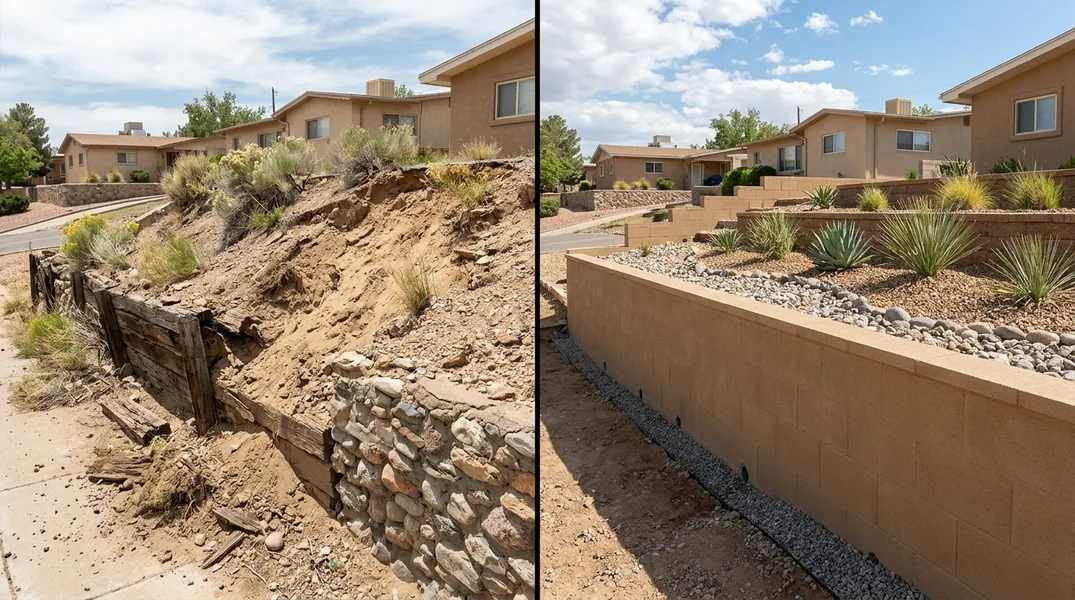
Why High Desert Walls Lean Differently Than You Might Expect
If you have noticed your retaining wall starting to lean, you are not alone. In Albuquerque, the combination of intense sun, seasonal monsoon rains, and expansive clay soils puts constant stress on any wall holding back earth. A wall that looks slightly off plumb after a wet summer is not necessarily failing, but it is sending you a message worth listening to. The high desert climate creates a specific set of pressures that homeowners in wetter regions rarely deal with, and understanding those pressures is the first step toward making a smart repair or replacement decision.
Our soils swell when they absorb water and shrink as they dry, and that cycle repeats every year. When water collects behind a wall, hydrostatic pressure builds up and pushes the structure forward. Meanwhile, the freeze-thaw cycles we see in colder pockets around the valley can loosen mortar joints and shift individual blocks or stones. A leaning wall in this environment is often a drainage problem before it is a structural problem, which is good news for many homeowners. Identifying the root cause early is what separates a modest Retaining Wall Repair from a full rebuild.
Leaning Retaining Wall Repair: When It Makes Sense
Not every lean means the wall is doomed. If the movement is minor, if the wall is relatively short (under about four feet), and if the surrounding soil and base look intact, repair is often the most economical and least disruptive option. A professional assessment can determine whether the footing is still stable and whether the lean is caused by poor drainage, root intrusion, or a failing connection between the wall and the slope. In many cases, correcting the drainage behind the wall and resetting the affected sections restores both function and appearance for years to come.
Leaning retaining wall repair is a common request for us because so many older walls were built without proper gravel backfill or weep holes. When we open up a wall and find that water has been trapped behind it, we can install a drainage system that relieves pressure and helps the wall stay straight. If your wall is showing early signs of movement but has not yet cracked or bulged significantly, it is worth getting a professional opinion before the problem grows. A timely repair protects your landscaping, your patio, and the foundation of nearby structures, and it usually costs far less than waiting for a failure.
Retaining Wall Crack Repair: What Cracks Tell You
Cracks are the other big warning sign, and they come in two basic flavors. Hairline cracks in the surface of concrete or mortar are usually cosmetic and can be sealed as routine maintenance. But cracks that run diagonally across a wall, widen over time, or appear alongside a lean are structural red flags. Those patterns suggest that the wall is moving as a unit or that the soil beneath one section has settled differently from the rest. In Corrales and other areas with variable soil conditions, differential settlement is a frequent culprit behind serious cracking.
Retaining wall crack repair can be very effective when the crack is caught early and the underlying cause is addressed. We often see cracks that were simply patched cosmetically, only to reopen within a season because the pressure behind the wall was never relieved. If you have a crack wider than about a quarter inch, or one that has visibly grown since you first noticed it, it is time to have the wall evaluated. Ignoring a structural crack is one of the most common ways a repairable wall becomes a replacement project, and that is a cost most homeowners would rather avoid.
When Replacement Is the Smarter Investment
Sometimes the honest answer is that replacement is the better path. If a wall is bulging outward, has multiple structural cracks, is taller than four feet without proper engineering, or has already failed once, patching it may only buy you a season or two. Walls that were built without adequate footings, drainage, or reinforcement are often working against physics from day one, and no amount of cosmetic repair will fix the underlying design. In those cases, a properly engineered Retaining Wall Replacement is the safer and ultimately more economical choice.
Replacement does not have to mean the same wall you had before. Modern Concrete Retaining Walls and engineered block systems are designed to handle the expansive soils and monsoon runoff common in the Albuquerque area. A new wall built with proper drainage, geogrid reinforcement, and a solid base will outperform an older wall that was never designed for our conditions. If you are weighing repair versus replacement, a professional evaluation will give you a clear picture of what each option costs and how long each is likely to last, so you can make the decision with confidence rather than guesswork.
Retaining Wall Repair Near Me: Getting a Straight Answer
When you search for retaining wall repair near me, you want a contractor who will tell you the truth, not just sell you a new wall. A good evaluation starts with looking at the wall's height, age, materials, drainage, and the soil around it. From there, a professional can explain whether the movement is cosmetic, whether it is a drainage issue that can be corrected, or whether the structure has reached the end of its useful life. That conversation should include clear options and honest expectations, not pressure to choose the most expensive path.
At Albuquerque Retaining Wall, we serve homeowners throughout the metro area, including Rio Rancho and Los Ranchos de Albuquerque. Whether you need a small crack sealed, a leaning section reset, or a full replacement, we start with an on-site assessment and a clear explanation of your options. You can reach us at (505) 312-9278 or request a free estimate to get the process started. Our goal is simple: help you protect your property with the right solution for your wall, your budget, and your landscape.
What to Budget for Repair or Replacement
Cost is usually the question homeowners ask first, and the honest answer is that it depends on the wall. A minor repair, such as sealing cracks or correcting drainage, is typically a modest investment compared with rebuilding. A replacement, on the other hand, involves demolition, excavation, new materials, and proper engineering, so it carries a higher price tag. The key is to compare the cost of repair against the remaining lifespan of the wall. Spending a smaller amount now on a wall that will need replacement in two years is rarely a good deal, while a well-executed repair on a fundamentally sound wall can be money well spent.
We encourage homeowners to ask for a breakdown of options rather than a single number, and to review our pricing page for general guidance before calling. Factors that affect the final figure include wall height, length, material choice, access to the site, and whether engineering is required. A short conversation and an on-site look are usually enough to give you a realistic range, so you can decide between repair and replacement with your eyes open. Call (505) 312-9278 today, and we will help you sort out the right next step for your leaning wall.
Looking for a professional retaining wall contractor in Albuquerque? Albuquerque Retaining Wall responds fast for all your retaining wall needs.
Get a Free QuoteOur services: Retaining Wall Installation · Retaining Wall Repair · Retaining Wall Replacement