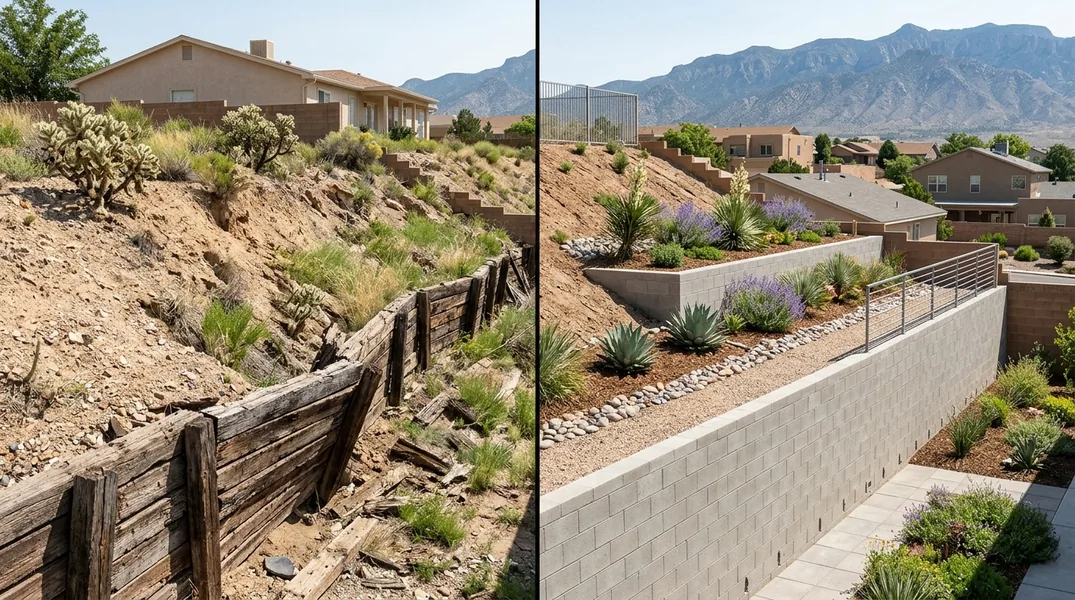
Why Albuquerque's Soil Makes Retaining Wall Material Choice Critical
If you live in Albuquerque, you already know that the ground here is not like the ground in most of the country. The city sits in the high desert, and the soil profile changes dramatically from one neighborhood to the next. In some areas you will hit loose, sandy soil that shifts with every monsoon storm. In others, you will strike caliche, a naturally cemented layer of calcium carbonate that can be harder than some concrete. And on the foothill lots along the east side, you are dealing with rocky, sloping terrain that sheds water fast and erodes quickly when it does not.
These conditions matter because a retaining wall is only as good as the material holding it up and the drainage system behind it. A wall that works beautifully in a Midwest clay yard may fail here within a few seasons if it cannot handle the expansive soils, the intense sun, and the sudden downpours. Choosing the right material is not just about looks. It is about structural longevity, drainage, and how the wall will perform after years of freeze-thaw cycles in winter and 100-degree summers. This guide breaks down the best options for sandy soil, caliche, and foothill lots so you can make an informed decision before you invest.
Concrete Retaining Walls: The Heavy-Duty Choice for Caliche and Foothill Lots
Concrete Retaining Walls are often the best fit when you are dealing with caliche or a steep foothill lot. Poured concrete is extremely strong and can be engineered to handle the lateral loads that come with holding back heavy, rocky soil. On a sloped lot where the grade changes significantly, a poured concrete wall can be designed with a batter (a slight lean into the hill) and a proper footing that reaches below the caliche layer. That gives you a wall that will not shift or crack when the ground moves.
Concrete also performs well in sandy soil as long as the drainage behind it is handled correctly. Because sand drains quickly, water can build up behind a solid concrete wall and push against it if there is no gravel backfill and weep system. A professional installer will always include drainage. The other advantage of concrete is that it can be finished in many ways, from smooth to textured, so it can look clean and modern or blend into a natural landscape. The trade-off is that concrete walls usually require more site work and a longer cure time, which can affect your schedule and your pricing. For many homeowners in Rio Rancho and the foothills, though, the durability is worth it.
Block Retaining Walls and Segmental Retaining Walls: Versatile and Cost-Effective
Block retaining walls, also known as segmental retaining walls, are one of the most popular choices in the Albuquerque area, and for good reason. These systems use interlocking concrete blocks that are designed to flex slightly with ground movement rather than crack. That flexibility is a real advantage in sandy soil, where minor settling is common. Segmental blocks also come in a wide range of colors and textures, so you can match the warm earth tones of the desert or create a clean, contemporary look. They are generally faster to install than poured concrete and often more budget-friendly.
The key to a successful block wall in sandy soil is the base and the geogrid. A segmental wall needs a compacted gravel base that is dug down below the frost line, and taller walls need geogrid reinforcement extending back into the soil to hold everything together. When installed correctly, a block wall can handle the shifting and settling that sandy soil is known for. If you are comparing options for a Retaining Wall Installation project, segmental walls are often the sweet spot between cost, appearance, and performance. They also work well on gentle slopes and terraced yards, which are common in Corrales and other parts of the metro.
Boulder Retaining Walls: A Natural Fit for Foothill and Sandy Soil
Boulder retaining walls are an excellent choice for homeowners who want a natural look that fits the high desert landscape. Large landscape boulders, often locally sourced, are stacked and set into the slope to create a wall that looks like it belongs there. On foothill lots with rocky, uneven terrain, boulder walls can follow the natural contours of the land in a way that rigid concrete or block walls cannot. They are also very effective in sandy soil because the gaps between boulders allow water to drain freely, reducing hydrostatic pressure behind the wall.
Boulder walls do have limitations. They work best for walls under about four feet tall, and they require careful placement so that each stone is stable and locked in. If a boulder wall is built poorly, it can shift or settle over time, especially on a steep slope. That is why it is important to work with an installer who understands the local geology. For homeowners in Los Ranchos de Albuquerque who want a rustic, low-maintenance wall that blends with the landscape, boulders are often the most attractive option. They also hold up well to the intense sun and dry conditions that define our climate.
Retaining Wall Installation Near Me: When to Call a Professional
If you are searching for retaining wall installation near me in the Albuquerque area, you are probably weighing whether to tackle the project yourself or hire a pro. The honest answer is that retaining walls are one of the most unforgiving DIY projects a homeowner can take on. The failure of a retaining wall is rarely gradual. It often happens suddenly, after a heavy monsoon rain, when the soil behind the wall becomes saturated and the wall gives way. In sandy soil, that risk is even higher because water moves through the sand quickly and can erode the base before you realize there is a problem.
A professional installer will evaluate your soil, calculate the loads, design the drainage, and choose the right material for your specific site. They will also know how to handle caliche, which may require specialized equipment to excavate. If you already have a wall that is leaning, cracking, or bulging, Retaining Wall Repair is often possible, but it needs to be assessed quickly before the damage spreads. In some cases, a full Retaining Wall Replacement is the safer and more cost-effective path. Either way, getting a professional opinion early can save you from a much bigger expense down the road. You can reach Albuquerque Retaining Wall at (505) 312-9278 to discuss your project.
Retaining Wall Installation Cost in Albuquerque: What to Budget
Homeowners often ask what a retaining wall will cost, and the truth is that there is no single number. The pricing depends on the material you choose, the height and length of the wall, the soil conditions, and how much site preparation is required. A short block wall on a gentle slope is a very different project from a tall concrete wall cut into a caliche hillside. Boulder walls tend to be priced per ton of stone, while segmental block walls are often priced per square foot of wall face. Concrete walls involve forming, pouring, and curing, which adds labor time.
In the Albuquerque market, most residential retaining walls fall into a range that reflects the local cost of labor and materials, but the only way to get an accurate figure is to have your site evaluated. Factors like access for equipment, the need for excavation through caliche, and the amount of drainage work required can all move the number up or down. It is worth getting a written free estimate that breaks down materials, labor, and drainage so you can compare apples to apples. A reputable contractor will also explain what is included and what is not, so there are no surprises once the work begins. Call (505) 312-9278 to schedule your on-site assessment.
Looking for a professional retaining wall contractor in Albuquerque? Albuquerque Retaining Wall responds fast for all your retaining wall needs.
Get a Free QuoteOur services: Retaining Wall Installation · Retaining Wall Repair · Retaining Wall Replacement